Strua is designed for adults aged 18 and over.
“I built the between-session system I wished I had years ago, and I want clinicians to evaluate it for themselves.”
— Dr. Nicholas Gehle, Psy.D. · Licensed Clinical Psychologist
Evaluate Strua for free and decide if it is useful for your clients.
60+ psychologist-built tools informed by established coping frameworks · 41 Why This Works articles · 100+ peer-reviewed citations
Designed to support therapy — not replace it.
BUILT FOR THE MOMENTS COPING SKILLS ARE HARDEST TO REACH.
Breathe with this. We'll wait.
What someone sees at 2 AM
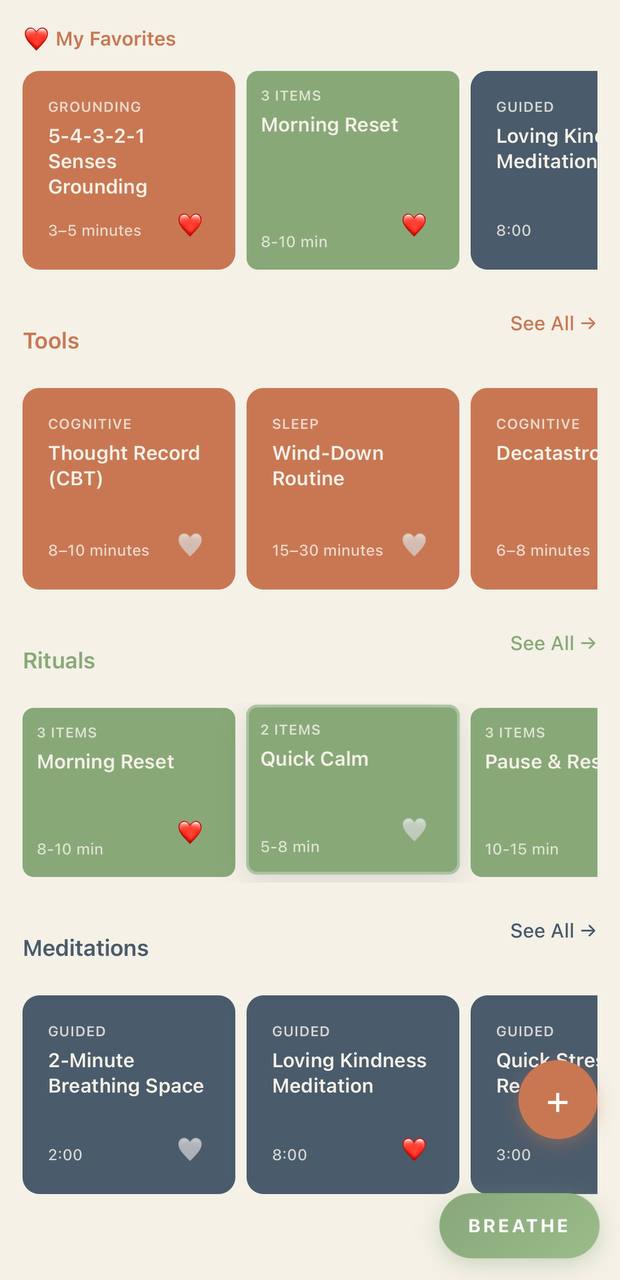
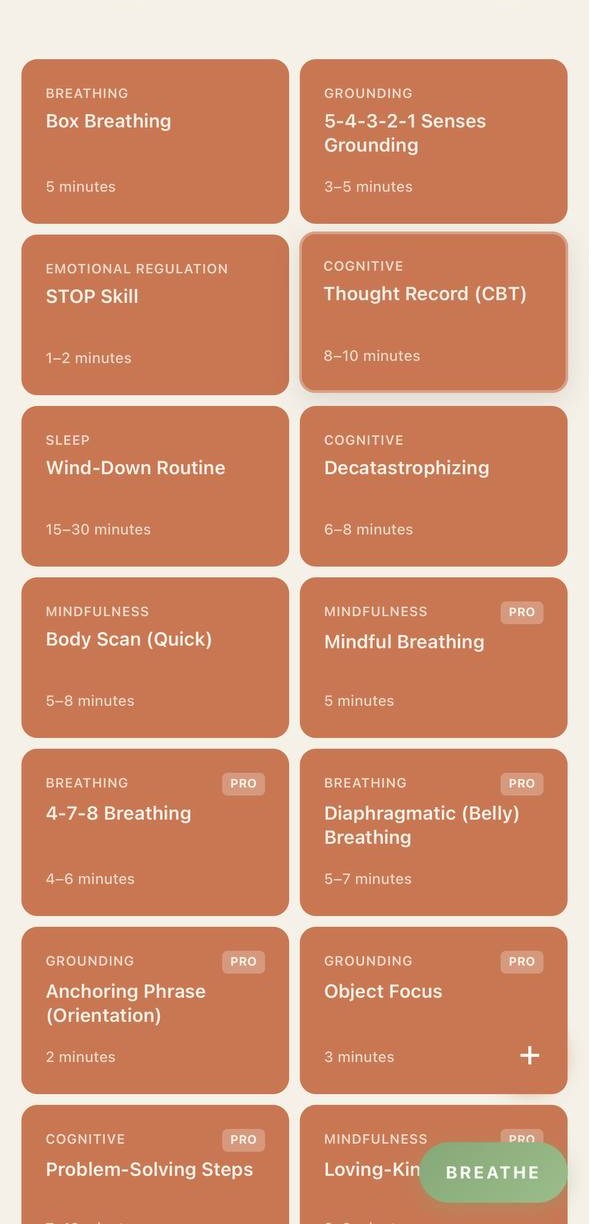
Tools, rituals, and guided meditations — all clinician-authored, structured, and accessible in 2 minutes.
Why this exists
The crisis amnesia gap
People learn diaphragmatic breathing, cognitive restructuring, the 5-4-3-2-1 grounding sequence. They can recite the steps in a session. Then the panic hits at 2 AM and the skills evaporate. They say at the next session: "I couldn't remember what to do." This is the gap between acquisition and retrieval that every clinician sees — and it's the gap Strua was built to close.
Why I rejected the chatbot model
I do not currently believe AI chatbots have the clinical guardrails to act autonomously in mental health care, and I've chosen not to include them in Strua. The user experience is entirely structured, deterministic, and clinician-authored. No generative AI in the user-facing experience. No hallucination risk. No sycophancy. No manipulation. If that calculus ever changes, it'll be because the guardrails meet a standard I'd accept for my own clinical work — not before.
What I built instead
Strua is a library of structured, psychologist-built coping tools — breathing protocols, grounding sequences, CBT thought records, DBT distress tolerance skills, mindfulness practices — delivered through a guided, deterministic interface. When someone opens Strua, they're using exercises informed by clinical practice — as a self-guided tool, not as care delivery. No improvisation, no generative content.
Built for the work between sessions.
Four things I kept coming back to while designing Strua.
Bridge the Gap
Your clients practice CBT, DBT, grounding, and mindfulness skills in their own environment, in the moment they actually need them.
Privacy by Design
Personal reflection content is designed to remain on the user's device. Strua is designed as a consumer self-support tool and is not designed to receive or store PHI.
Light-touch entry
A brief walkthrough on first login, then a short check-in that suggests a starting point. No referral codes, no profile build. Users can skip the check-in and go straight to any tool.
Clinical Integrity
Every tool is designed by a licensed clinical psychologist and cites its peer-reviewed evidence base in the references library.
What users get access to
Users can personalize tools — adjust a breathing pattern, choose a grounding sequence, or tailor a cognitive worksheet to their preferences — and use them whenever they want.
Every interaction is clinician-authored content delivered structurally. No generative AI in the user-facing experience.
CBT (Thought Record, Decatastrophizing, Problem-Solving Steps), DBT skills (STOP, Cold Splash on Wrists, Pause and Breathe), breathing protocols (Box Breathing, 4-7-8, Diaphragmatic, Mindful Breathing), grounding (5-4-3-2-1 Senses, Anchoring Phrase, Object Focus), mindfulness (Body Scan, Loving-Kindness Minute), sensory regulation (Warm Drink Ritual, Soothing Music Session), movement (Five-Minute Walk), and sleep (Wind-Down Routine, Soothing Breath Count). Every tool references established coping frameworks and peer-reviewed literature.
Core reflection content is designed to remain on the user's device. Only authentication information syncs to our servers. No third-party tracking, no advertising, nothing sold to data brokers.
No streaks, no guilt notifications, no shame mechanics. Used when needed, not daily-use habituated.
A short check-in suggests a starting tool. No profile build required. Can skip anytime.
Early clinician feedback
Strua is an amazing resource that I recommend for my clients to help them build emotional resilience. Strua offers practical tools that help my clients stay engaged in their mental health journey, especially in between therapy sessions.
Dr. Roxanne Cole, Psy.D.
Licensed Clinical Psychologist · Florida
Clinician Access Program
Evaluate Strua for free and decide if it is useful for your clients.
As a CAP member, you receive:
- ✓Free Pro access for evaluation
- ✓A client coupon (STRUAWELCOME) for clients who want to try Strua
- ✓A clinician welcome packet — a printable poster, client cards, and a handout to introduce Strua in session
This is a professional access program. Not a referral system. Not an affiliate program. There's no client-to-clinician linkage, no attribution tracking, no commissions. What you do with Strua in your practice is between you and your clients.
Approval is manual and open to licensed mental health clinicians globally — psychologists, psychiatrists, counsellors, social workers, and comparable regulated credentials in your jurisdiction. For students, trainees, or adjacent roles, email Dr.G@strua.app directly and we'll figure out what makes sense.
Want to evaluate everything first? See the full Clinician Resource Hub — who built it, privacy, evidence base, and how clients use it, organized on the APA App Advisor model.
Received — thank you.
Dr. G reviews each application personally, usually within 2–3 business days, and you'll get an email once you're approved.
If you don't see our confirmation email in your inbox shortly, please check your spam or junk folder. Our follow-up approval email may also land there.
Something went wrong. Please try again or email Dr.G@strua.app directly.
About me
Dr. Nicholas Gehle, Psy.D.
Licensed Clinical Psychologist · Founder, Strua
I'm a licensed clinical psychologist. My full-time job is in psychological assessment and diagnostic evaluations, where I see the downstream consequences of untreated and undertreated mental health every week. I built Strua because I kept watching patients walk out of sessions equipped with skills they couldn't retrieve when they needed them most, and because the AI therapy products filling the gap are missing the clinical safeguards that I believe are necessary for that type of engagement. Strua is my attempt at what an evidence-informed, clinician-designed alternative actually looks like.
If you also run a private practice
I built a free website Recognition Score that shows what a new client — and an AI — can tell about your practice in seconds: struapractice.com. A gift, not a pitch.
Have questions? Want to talk?
I read every email. If you're a clinician evaluating Strua for your practice or want to discuss Strua's approach to AI in mental health, I'd like to hear from you.